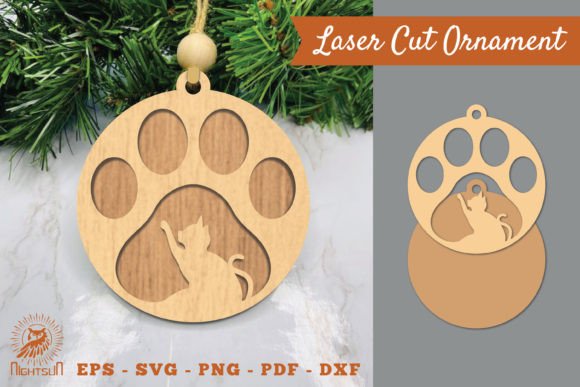
Cat Memorial Ornament Laser Cut Design
A Quiet, Thoughtful Shape—Not Just Another Silhouette
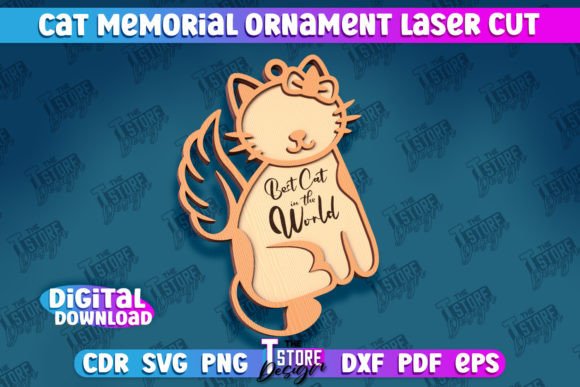
First impression? This isn’t a playful cartoon cat or a stylized logo—it’s a soft, reverent outline: a seated feline with delicate angel wings, centered and balanced. The lines are clean but not clinical; there’s gentle curvature in the spine, a subtle curve to the wingtips, and space built into the negative areas. As an embroidery designer who’s stitched hundreds of memorial pieces, I immediately felt its emotional weight—and its practical potential. It reads clearly at 3.5" tall, holds detail without overcrowding, and doesn’t rely on tiny interior cuts or fragile bridges that fray under thread tension.
Where It Lives Best: Real Projects, Not Just Mockups
Last week, I used Cat Memorial Ornament Laser Cut Design as the centerpiece for a custom embroidered linen tea towel—intended as a condolence gift for a client who’d lost her 17-year-old tabby. I paired it with a simple running-stitch border and hand-embroidered “Always With Us” in a quiet script below. The result wasn’t flashy—but it was unmistakably handmade, tender, and grounded. That’s the sweet spot: nursery decor, keepsake pillow covers, framed hoop art, baby blankets (with wings subtly repositioned upward for gentleness), and small-batch holiday ornaments sold in local boutiques or on Etsy.
It also translates cleanly to embroidered patches—especially when backed with lightweight fusible stabilizer and finished with satin-stitched edges. I tested it on a twill cap front (hoop size 4"x4") and found the wing span fit comfortably within standard cap zones, with enough breathing room to avoid puckering. For sweatshirt embroidery, I recommend keeping it under 4" wide to preserve stitch clarity on textured fleece.
Where to Pause—And Why
This design shines on stable, medium-weight fabrics: cotton canvas, linen, denim, quilting cotton, and midweight twill. But tread carefully on stretchy knits (like jersey t-shirts) unless you’re using high-quality cutaway stabilizer and reducing stitch density in the wing areas. Thin fabrics—think baby muslin or lightweight chambray—can show shadowing from dense fill stitches beneath the wings, so test with a single-layer stabilizer first.
Dark fabric demands thoughtful thread choice. The silhouette’s strength lies in its contrast—not fine detail—so avoid light pastel threads on navy or charcoal. A deep charcoal gray or matte black thread gives dignity without glare. And while the design *looks* minimal, don’t underestimate its stitch density in the wing feathers: those layered fill stitches can compress on plush towels or thick blankets, blurring definition. A quick stitch-count check (if your software shows it) or a test run on scrap helps avoid surprises.
Small Hoops? Yes—But Mind the Wings
I ran Cat Memorial Ornament Laser Cut Design in a 3.25" round hoop for a set of mini embroidered coasters. It worked—but only because I slightly adjusted the wing angle inward (a 5° rotation) to keep both tips fully inside the hoop boundary. No auto-scaling. No distortion. Just smart, respectful adaptation. If you’re selling digital embroidery files, note this flexibility: buyers appreciate knowing it’s adjustable without losing integrity.
What It Adds—Beyond Stitching
For Etsy sellers and craft business owners, this design carries quiet commercial strength. It’s emotionally resonant but never cloying. Customers searching for “cat memorial gift” or “personalized pet ornament” respond to its sincerity—not gimmicks. When stitched cleanly, it elevates perceived value: a $28 linen tote feels like a curated keepsake, not a generic craft item. And because it avoids text-heavy layouts or trendy fonts, it stays timeless across seasons and shop branding.
That said—don’t assume licensing covers resale of finished items. The product description says it’s for laser cutting machines (“RED line – CUT, BLACK line – ENGRAVE”), but makes no mention of embroidery use rights. Before listing embroidered pillows or patches for sale, verify whether the file includes commercial embroidery license terms. Many CNC designers restrict derivative uses unless explicitly stated.
Practical Notes Every Designer Should Run Through
- Test first—on the exact fabric + stabilizer combo you’ll use. Linen behaves differently than cotton duck; fleece hides detail faster than poplin.
- Check thread color contrast before stitching a full run—especially on off-white or oatmeal fabrics where beige thread can disappear.
- Review stitch density in the wing area. If your machine struggles with tight fills, reduce density by 5–10% and add a second pass if needed.
- Confirm hoop size compatibility—not just max dimensions, but how much margin the design needs for jump stitches and frame clearance.
- Inspect small corners: the inner curve where wing meets body should stitch cleanly without thread nesting—look for that in your preview.
- Mock it up in black and white first. If the shape loses legibility without color, it may need simplification for small-scale projects.
- Use proper stabilizer: tear-away for stable wovens, cutaway for knits or high-loft fabrics, and lightweight mesh for delicate linens.
- Confirm dual-use suitability: does it work equally well for personal keepsakes *and* client-facing boutique products? This one does—if stitched with care.
Final Thought: It’s Not Just a Design—It’s a Moment Given Form
As a designer who’s stitched memorial pieces for grieving parents, hospice volunteers, and rescue org fundraisers, I know how much weight a single image carries. Cat Memorial Ornament Laser Cut Design earns its place—not through complexity, but through restraint. It doesn’t shout. It settles. And in embroidery, where every stitch is a decision, that kind of intention matters most. Use it thoughtfully, test it thoroughly, and let the quiet strength of the shape speak for itself.